Citrus Cottony Scale and Elongate Cottony Scale: Identification, Biology, Damage and Control
Learn about citrus cottony scale (Pulvinaria aurantii) and elongate cottony scale (Pulvinaria floccifera), including their morphology, life cycle, overwintering, damage symptoms, distribution and control methods.
Citrus Cottony Scale
Pulvinaria aurantii

Introduction
Citrus cottony scale was introduced into Iran sometime between 1318 and 1346 (Iranian calendar years). It was first observed on citrus trees in the cities of Rasht and Bandar Anzali in 1325. In addition to citrus, this pest has also been observed on an ornamental shrub known as Pittosporum tabria along the forest margins of the Salman Shahr region, and occasionally on Japanese loquat and oleander (Farahbakhsh, 1351; Davachi and Taghizadeh, 1333).
Morphology
Adult Female:
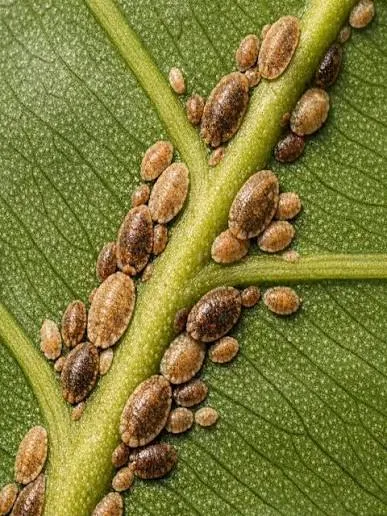
The adult female of citrus cottony scale is oval-shaped and slightly convex, measuring 3.5 mm in length and 3 mm in width. Its body is greenish-brown, with a darker brown stripe extending along the dorsal surface.
The egg sac secreted from the posterior end of the female's body resembles that of the Australian cottony cushion scale, but differs in being flat and lacking longitudinal grooves. The egg sac is relatively short and broad, measuring approximately 7 mm in length and 4 mm in width (Davachi and Taghizadeh, 1333).
During egg-laying, the female's body becomes covered with a white, waxy substance.
Biology
Citrus cottony scale usually overwinters as a second-instar nymph. In Mazandaran, it has two generations per year, with most second-generation nymphs appearing from mid-September to mid-October.
The egg-laying period of the female is relatively long and lasts approximately one month on average. Eggs generally hatch within 12 to 14 days. Each female lays an average of 151 eggs, with a minimum of 49 and a maximum of 339 eggs.
After hatching, young nymphs move to the undersides of leaves, young shoots and occasionally the upper leaf surfaces, where they settle and feed on plant sap along the main leaf veins and their branches.
This pest produces large amounts of honeydew. As a result, leaves and branches may become heavily covered with sooty mold (Fumagine). Shoots infested by this pest show reduced growth and may eventually dry out (Jafari, 1372).
Damage Symptoms
Citrus cottony scale attacks leaves, fruits and young branches, covering their surfaces. Heavily infested trees become severely weakened, their leaves and fruits may drop, and young branches may dry out.
The feeding activity of this insect leads to the development of sooty mold (Fumagine) on the tree, making heavily affected trees recognizable from a distance.

Citrus cottony scale is distributed in the regions of Bandar Anzali, Rasht, Chalus and Gorgan.
The level of infestation in Bandar Anzali and Rasht is lower than in Gorgan. This is partly because severe cold in Gilan Province can cause damage to citrus trees and creates unfavorable conditions for the growth and development of this pest.
Furthermore, the presence of the parasitic fungus Cephalosporium lecanii in these regions contributes to significant biological suppression of the scale insect. In contrast, in Gorgan, lower humidity reduces the prevalence of this fungal disease on the scale insect, allowing the pest to become more severe (Davachi, 1328).
Another factor limiting the spread of this pest in Rasht is the relatively low density and wide spacing of citrus trees, which reduces the likelihood of its transmission from one tree to another (A. Behdad, 1315).
Control Methods
Products such as horticultural mineral oil (Volck oil), ethion and pyriproxyfen are mentioned for control. In more severe infestations, acetamiprid is also mentioned.
Elongate Cottony Scale of Citrus
Pulvinaria floccifera
Introduction
Elongate cottony scale of citrus was reported in Iran by Afshar in 1316. Since its egg sac is longer than that of other cottony scales, it is commonly known as elongate cottony scale.
In addition to citrus, this pest has been observed on several other plants, including tea, Japanese spindle, camellia, bay laurel and camphor.
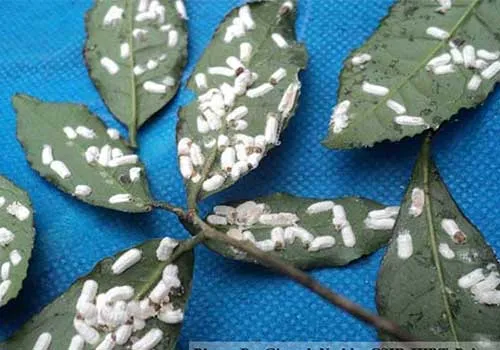
Elongate cottony scale is active mainly on the lower surface and, less frequently, on the upper surface of citrus leaves. It may also infest young branches, but it is never found on fruits.
Infested trees are often affected by sooty mold, which can cause them to turn black and become recognizable from a distance.
This pest is widespread along almost the entire northern coastal region of Iran, extending from Astara to Gorgan. However, its distribution is more extensive in Tonekabon and Mazandaran than in other areas.
Morphology
Adult Female:
The adult female is greenish-yellow to light brown, oval-shaped and slightly convex. Its body measures approximately 2.5 to 3.5 mm in length.

Egg Sac:
The egg sac is narrow and elongated, reaching up to 12 mm in length, while its width does not exceed 2 to 2.5 mm. It is snow-white in color.
The nymphs are broad and greenish in color. They are usually concentrated around the veins on the lower surface of leaves.
Overwintering
Elongate cottony scale of citrus usually overwinters as a second-instar nymph beneath the leaves of evergreen citrus trees.
The nymphs reach adulthood in late May, after which the females begin secreting their egg sacs and subsequently lay eggs.
Eggs
Each egg sac may contain up to 2,000 eggs. The eggs are oval-shaped and yellowish-brown in color.
Nymphs
Young nymphs emerge from the eggs two to four weeks after oviposition. They disperse in large numbers across the undersides of leaves and along branches.
After moving for several hours, they eventually settle around the leaf veins.
During this period, wind can easily carry the nymphs from one tree to another.
The nymphs do not produce waxy secretions and are morphologically similar to those of citrus cottony scale (Davachi and Taghizadeh, 1333).
Number of Generations
This pest has one generation per year.
Control Methods
This pest is heavily attacked by the parasitic fungus Cephalosporium lecanii. Therefore, chemical spraying is often unnecessary.
However, in areas where this fungal pathogen is absent, spraying may be carried out in early summer during the emergence of young nymphs.
Mentioned control products: Ethion and horticultural mineral oil (Volck oil).