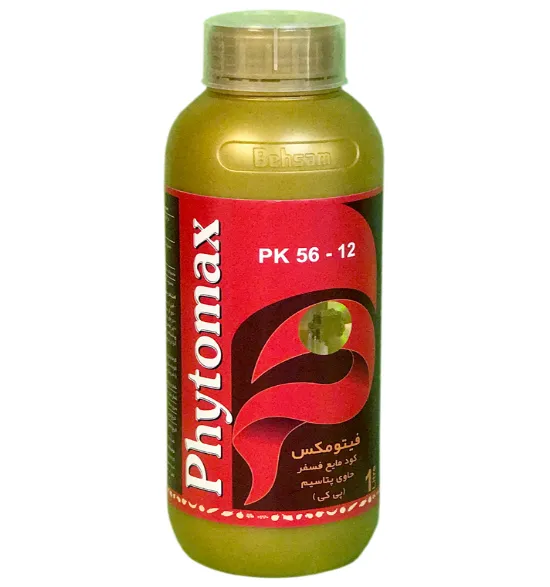
Phytomax Liquid Phosphorus–Potassium Fertilizer (PK) (W/V) 12-56-0
Phytomax PK fertilizer provides plants with two essential macronutrients — Phosphorus (P) and Potassium (K). Phosphorus strengthens stems and roots, enhances the plant’s energy storage capacity, and consequently increases overall yield. It is most effective when applied during the early stages of growth, allowing the plant to utilize the stored energy during reproductive phases.
Phytomax Liquid Phosphorus–Potassium Fertilizer (PK) (W/V) 12-56-0
0-56-12 (W/V) Phytomax Liquid
Phytomax PK fertilizer provides plants with two essential macronutrients — Phosphorus (P) and Potassium (K).
Phosphorus strengthens stems and roots, enhances the plant’s energy storage capacity, and consequently increases overall yield. It is most effective when applied during the early stages of growth, allowing the plant to utilize the stored energy during reproductive phases.
Potassium plays a key role in water regulation, protein formation, starch and cellulose synthesis, cellular respiration, and enzyme activation. It also improves photosynthetic efficiency, facilitates nutrient transport through phloem, and contributes to fruit maturation and ripening.
Advantages and Features:
- Stimulates root development
- Acidic pH, suitable for calcareous soils
- Enhances availability of immobile nutrients in soil
- Promotes flowering and fruit set
- Improves storage quality and fruit coloration
- Increases plant resistance to drought and frost stress
Guaranteed Analysis:
| Element | W/W | W/V |
| Available Phosphorus (P₂O₅) | 38% | 56% |
| Water-Soluble Potassium (K₂O) | 8% | 12% |
Composition:
Phosphoric Acid, Potassium Hydroxide, and other auxiliary agents and emulsifiers.
Application Instructions:
| Crop Type | Foliar Application | Fertigation |
| Fruit Trees | 2–3 L per 1000 L water — 2–3 times during fruit growth and expansion at 10–14 day intervals | 8–10 L/ha — once in late winter and repeated in late spring |
| Field Crops | 2–3 L/ha — 2–3 times before and after flowering at 7–10 day intervals | 10–14 L/ha |
| Vegetable Crops | 2–3 L/ha | 10–14 L/ha |
| Greenhouse Crops | 2–3 L/ha | 10–14 L/ha |